Showing posts with label Auto Industry. Show all posts

Tuesday, April 30, 2013

A Tablet as a Replacement for, Not Addition to, a Car Display

Apparently Apple is in talks to do... something in along that line. It has had some niche successes with having auto makers use tablets instead of a proprietary in-car entertainment system. In past years the profit margins for entertainment and navigation systems would have made it difficult to convince auto makers to fully integrate with a third party device, but now... if you pay $2500 for in-car entertainment or navigation, or even $1,500, even if you don't feel like a chump it's difficult to imagine that you've viewed in any other manner by the car dealership.

So why not become, in essence, a large tablet retailer? Have the device fully integrate into the vehicle, seamlessly controlling navigation, entertainment, climate control, and the like? Sure, you have to somehow control for people watching movies while they drive....

Tuesday, May 08, 2012

It's the Same Way He Creates Jobs

He quits his job, jokes about being unemployed as he lives off of his deferred compensation (at a very favorable tax rate), becomes a perpetual vanity candidate for President, and seems most at home while talking about dressage, but none of that will stop Romney from taking credit for any positive thing that happens anywhere. Even if he opposed it at the time and has subsequently declared it to be a mistake.

He also would have ordered the raid on Bin Laden, offering a reinvention of his statements that he would not go into Pakistan and did not view the pursuit of Bin Laden as a worthwhile effort. And he hates his own health reform plan, having stripped out of his book the expression that "We can accomplish the same thing [as the Massachusetts health insurance reform] for everyone in the country", well, the polls!

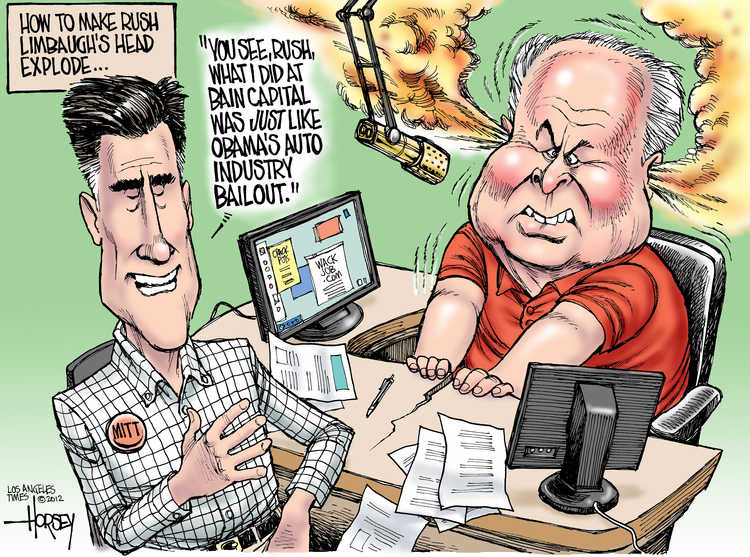
I'm not sure whether the following better represents what goes on in Romney's head, or what goes on in the heads of his supporters....


Update: TPM offers the reaction of Steven Rattner to Romney's self-aggrandizement,
“I’ve read, I think, everything Romney’s had to say on this subject, and the level of flip-flopping and dissembling is truly mind-boggling,” Steve Rattner, the “auto czar” who advised the White House on the auto rescue, told TPM. “He’s been on every side of the auto rescue at different times and said different things, so it’s hard to know what he honestly thinks.”
Update: Jamelle Bouie makes a funny (based, I expect, on the movie version of the characters):
On this, Mitt Romney is the Winklevii to Obama’s Zuckerberg; sure, Obama developed and implemented the auto bailouts, but Romney had the same idea and therefore, he should receive the credit. My guess is that this won’t catch fire with voters, or anyone who has experience with the naysayer who claims retroactive credit for success.
Alas, Jamelle's comment reminds me both of a quote attributed to Mencken and of which of the two men is rich.

Tuesday, February 14, 2012

Romney's Dishonest Pitch to Michigan Voters

Mitt Romney has a problem in Michigan. Four years ago, part of his case for his candidacy was that he could deliver Michigan for the Republican Party. He won the primary, but with less than 40% of the vote. Now he's the presumed nominee, and he may lose Michigan to, of all people, Rick Santorum. Then, as now, Romney claimed a form of inherited connection with the state and auto industry that, like pretty much everything else he claims, just doesn't ring true for a lot of the voters he expects to support him.

Four years ago, Romney argued that we should "let Detroit go bankrupt."
If General Motors, Ford and Chrysler get the bailout that their chief executives asked for yesterday, you can kiss the American automotive industry goodbye. It won’t go overnight, but its demise will be virtually guaranteed.
Can you feel his brilliant business insight at work? He follows that up with a number of observations that range from the trite (the need to renegotiate labor contracts for lower wages and benefits, the need to replace bad management, the need to focus on a long-term strategy and not simply he next quarter's financials), and suggests that the auto industry is the wrong place to spend government money,
I believe Washington should raise energy research spending to $20 billion a year, from the $4 billion that is spent today. The research could be done at universities, at research labs and even through public-private collaboration.
Yes, that's right, Romney was for massive public investment in companies like Solyndra before, with the benefit of hindsight, he was against them. It's astonishing that a guy who claims to be a genius venture capitalist believes that you can invest $20 billion in research without taking any losses. Most good venture capitalists have a success rate of what, one in three?
Let's start with my 1/3, 1/3, 1/3 assumption that regular readers will be familiar with. This says that 1/3 of an early stage venture portfolio will be losers, 1/3 will get your money back or make a little money, and only 1/3 will deliver the kind of performance you expect when you make an investment (5-10x).
Romney complains when people criticize his record at Bain, and point to the companies that ended up failing, but he predictably applies a very different standard when going after the President. Solyndra obtained almost a billion dollars in private equity - money from companies like Bain - prior to its collapse. Romney can argue that the scale is different, an argument undermined by his own assertion that the federal government should push $20 billion into alternative energy research, but as others have pointed out the entire effort resembles a push Romney made as governor of Massachusetts, with some of his administration's selections for the receipt of millions in grants ultimately failing. By the time he was criticizing Solyndra, Romney had either forgotten or flip-flopped on his proposed $20 billion budget for energy research, with a campaign spokesperson arguing, "Gov. Romney worked to limit the role of the state as venture capitalist". As a former head of the Massachusetts fund argues,
"[Romney's] administration was certainly at that point willing to support the establishment of a fund that was going to be in the business of giving money to individual companies and in effect picking winners," Leon said. "This is true. In some ways, it's a question of on what basis one wants to be critical of his position now."
Romney's other arguments about Solyndra seems remarkably detached from reality,
"When they put $500 million into Solyndra, they thought they were encouraging solar energy in this country," Mr. Romney told a friendly audience packed with business executives. "They did the opposite. Because when they put $500 million into Solyndra, the other 100 entrepreneurs in America working on solar energy just lost any potential to get capital."

He added: "When the government chooses to put in $500 million, who wants to put $2 million in some idea from this person in Montana? No one."
Seriously, not one venture capitalist in the country will invest in alternative energy if the U.S. government is providing loan guarantees to large ventures that have been vetted and funded by large venture capital firms? And his evidence for this is... that it makes for a great, if mendacious, sound bite in his speech?

You could argue that the U.S. government was following Romney's advice, creating a program that offered a total of about $20 billion in loan guarantees, and that it has a pretty remarkable record, having only one company (Solyndra) default. Perhaps Romney would like to bring out a panel of working venture capitalists, and have them explain how a 2.5% default rate on their investments would bring their companies to their knees. And while Romney likes to bandy about phrases like "crony capitalism" for why the Obama administration (like the V.C. firms that invested the $billion) thought Solyndra was an appropriate recipient for government support, he omits mention of the fact that Solyndra started to receive loan guarantees during the Bush Presidency.
What critics fail to mention is that the Solyndra deal is more than three years old, started under the Bush Administration, which tried to conditionally approve the loan right before Obama took office. Rather than “pushing funds out the door too quickly,” the Obama Administration restructured the original loan when it came into office to further protect the taxpayers’ investment.
If Romney is a brilliant businessman and investor, he knows all of this.

Moving back to Detroit, Romney whines that when the government restructured G.M. it gave a block of shares to the union,
Instead of doing the right thing and standing up to union bosses, Obama rewarded them.

A labor union that had contributed millions to Democrats and his election campaign was granted an ownership share of Chrysler and a major stake in GM, two flagships of the industry.
The first statement is an outright lie. Unions had to make significant concessions as part of the restructuring deal. The "ownership share" was part of the negotiation between the unions and the failing auto companies, and was designed to ensure at least partial continuation of medical benefits to retirees.
In virtually every respect, the concessions that the UAW agreed to are more aggressive than what the Bush Administration originally demanded in its loan agreement with GM. Among other things, the UAW’s existing VEBA – to which GM has a $20bn obligation – will be replaced by a new VEBA as described below....

This new GM will establish an independent trust (VEBA) that will provide health care benefits for GM’s retirees. The VEBA will be funded by a note of $2.5 billion payable in three installments ending in 2017 and $6.5 billion in 9% perpetual preferred stock. The VEBA will also receive 17.5% of the equity of New GM and warrants to purchase an additional 2.5% of the company. The VEBA will have the right to select one independent director and will have no right to vote its shares or ther governance rights.
Let's contrast the type of private investment that Romney implicitly argues is superior, and which he practiced back in his days with Bain,
The [investors] who ran Harry and David into the ground have a defense: economic conditions changed in unforeseeable ways. But that’s precisely why loading firms with debt in order to reap short-term benefits is bad. It leaves companies unable to weather tough times, and allows private-equity firms to make money even if things go wrong.

As if this weren’t galling enough, taxpayers are left on the hook. Interest payments on all that debt are tax-deductible; when pensions are dumped, a federal agency called the Pension Benefit Guaranty Corporation picks up the tab; and the money that the dealmakers earn is taxed at a much lower rate than normal income would be, thanks to the so-called “carried interest” loophole. The money that Mitt Romney made when he was at Bain Capital was compensation for his (apparently excellent) work, but, instead of being taxed as income, it was taxed as a capital gain. It’s a very cozy arrangement.
Recall also that before the government stepped in, Chrysler was not a publicly traded company. It was privately held by Cerberus Capital Management, a company that appeared adept only at running the company into the ground. In Romney's book, it appears to be a very good thing for a corporate raider to be able to pick the meat off a company's bones, leaving it to the taxpayer to cover defaults on pensions and retiree medical benefits. Surely he understands that the calculus is different when you're a government actor and you care less about profit than the survival of the company and the avoidance of an additional burden on the taxpayer. If Romney doesn't understand the difference between being President and running Bain, he has no business running for President.

Romney is now purporting that everything good about the government bailout of G.M. and Chrysler was his idea, and that everything else about the bailout was bad. Well before this speech was made, Paul Krugman gave an apt assessment:
So what the story of Romney and the auto bailout actually shows is something we already knew from health care: he’s a smart guy who is also a moral coward. His original proposal for the auto industry, like his health reform, bore considerable resemblance to what Obama actually did. But when the deed took place, Romney — rather than having the courage to say that the president was actually doing something reasonable — joined the rest of his party in whining and denouncing the plan.

And now he wants to claim credit for the very policy he trashed when it hung in the balance.
Romney he wants us to imagine that in private hands a company like Chrysler could have survived and thrived, ignoring the fact that Chrysler had spent years in the tends of people like Romney who were either indifferent to its survival or beyond incompetent in their effort to engineer a turnaround. He wants us to believe that G.M. and Chrysler could have survived a private bankruptcy, despite the far that credit markets were frozen and nobody was going to finance the companies' operations over the course of a traditional bankruptcy, even if expedited. He wants us to imagine that GM's bondholders, and Chrysler's private owners, were somehow duped or tricked into believing that they would do as well or better through the Obama Administration's plan that they approved, as opposed to rejecting the deal and pursuing a traditional bankruptcy. And, as a brilliant investor, Romney now encourages the Obama Administration to inflict a massive financial loss on the taxpayer, apparently because this will somehow punish the UAW.
American taxpayers have been left on the hook for billions to benefit unions and the union bosses who contributed millions to Barack Obama's election campaign. Such a state of affairs is intolerable, and as president I would not tolerate it. The Obama administration needs to act now to divest itself of its ownership position in GM.

The shares need to be sold in a responsible fashion and the proceeds turned over to the nation's taxpayers.
I recognize that anti-union demagoguery is par for the course for the Romney campaign, but you would think that in using the word he would have some sense of what it means to be responsible. The numbers are pretty basic: To recoup its 'investment' the government needs to sell its stake in G.M. at $53 per share. The present value of G.M. is $25.33 per share. Were the Obama Administration to follow Romney's advice, they would be "turning over" to the taxpayer a loss of about $20 billion. How can you view Romney's pressure for divestment as anything but dishonesty, demagoguery - a single (albeit very large) company's failure that results in a $500 million default on loan guarantees is government at its worst, but inflicting a $20 billion loss on taxpayers would be "responsible".

Friday, January 13, 2012

The Auto Bailout - Venture Capitalism in Action?

Mitt Romney's position on the auto industry bailout has been anything but consistent, but his latest spin is to try to compare the process of the bailout to the actions of a venture capitalist. Paul Krugman points out that Romney is now trying to claim a form of "credit for the very policy he trashed when it hung in the balance",
So what the story of Romney and the auto bailout actually shows is something we already knew from health care: he’s a smart guy who is also a moral coward. His original proposal for the auto industry, like his health reform, bore considerable resemblance to what Obama actually did. But when the deed took place, Romney — rather than having the courage to say that the president was actually doing something reasonable — joined the rest of his party in whining and denouncing the plan.
But there's something else we need to recall: at the time of the bailout, Chrysler was not a publicly traded company. It had been acquired and mismanaged by a private equity firm.

I don't want to overstate Obama's role in the bailout, as I don't think President Bush would have done things much differently, but here's the thing: President Obama pushed Chrysler through a managed bankruptcy after the private equity process failed. You can't say "It's the same thing a private equity firm would have done" because we know what the private equity firm actually did before the government had to take over and clean up its mess.

Update:

How to Make Rush Limbaugh's Head Explode

Monday, December 19, 2011

Jeb Bush Flatlines in the WSJ

Jeb Bush seems to be trying to set himself up as the candidate people wish had run for the Republican nomination. It's a "Don't pay any attention to what I did as governor (or what my brother and father did as Presidents, or what my grandfather did as a Senator) - I've discovered Ron Paul and libertarianism, and regret "succumbing" to the temptation to "do something" about economic problems.

The short version is that Jeb has supposedly been moved by Ron Paul's allusion to "The right to rise" as a "core concept of economic freedom", and as a result wants to free businesses of regulation and to free individuals from any form of government assistance.
We have to make it easier for people to do the things that allow them to rise. We have to let them compete. We need to let people fight for business. We need to let people take risks. We need to let people fail. We need to let people suffer the consequences of bad decisions. And we need to let people enjoy the fruits of good decisions, even good luck.
You know, like being born to a family that has been fabulously wealthy and politically connected for more than a century. The sort of fortunate birth that many people confuse with qualification for public office, but that's apparently something we are now supposed to celebrate rather than regret in the wake of a duopoly of increasingly disastrous Bush presidencies. (Anybody wanna go for a trifecta?)

The primary target of Jeb's editorial is regulation, which he tells us "abridge our own economic freedoms". He paints with an incredibly broad brush, but fails to identify any actual regulation that he sees as harmful, or to identify any actual harm. I don't think that's because he could not identify a regulation in which the costs and benefits were out of balance. I suspect that it's because to do so would reveal that this is penny ante stuff - that he could not identify any significant impediments to big business arising from regulation and that people would very easily identify the need for the regulations he specifically described even if agreeing that they should be modified.

It is fair to say that regulation of business impairs the ability of small businesses to enter highly regulated markets, and to compete with larger businesses that have legal departments that allow them to navigate or bypass regulation. But it's also fair to observe that as much as businesses rail against regulation, they recognize that complexity can be their friend - a clear regulation must be obeyed, while labyrinthine regulations are inevitably full of loopholes. Simple regulation also doesn't serve as a barrier to entry, while complexity may deter competitors from entering their markets. A similar phenomenon can be seen with newer high tech companies complaining about patents as a barrier to their success, and then not seeming so bothered by them after they build their own catalog of patents to use to threaten or negotiate with competitors.

But Jeb is speaking about personal freedom, and he provides no link between the regulation of businesses and the freedom of individuals. Having supposedly been inspired by Ron Paul, perhaps he has been listening to some of Paul's inanities on libertarian markets. As much as a certain faction of right-winger would like to pretend otherwise, history's lesson is clear: In the absence of regulation, business and wealth run roughshod over individual rights and freedoms.

Jeb offers some stump speech-style rhetorical questions,
Have we lost faith in the free-market system of entrepreneurial capitalism? Are we no longer willing to place our trust in the creative chaos unleashed by millions of people pursuing their own best economic interests?
If you succumb to the temptation to answer the questions, they're easily revealed as simplistic and inane. But that's not the point. Jeb is suggesting that there's a horrible "other" at work in our government that is out to undermine "entrepreneurial capitalism" and individual economic freedom and, implicitly, that it's men like him who are the answer... that is, now that they're out of power and no longer "succumb" to the temptation to pass the regulations that they would not dream of passing if they are returned to power.

When Jeb says, "We see an industry dying and we demand it be saved," I expect that he's speaking of the domestic auto industry, more specifically of GM and Chrysler, that both his brother and President Obama thought necessary to save within the context of a massive economic meltdown. Except the auto industry was not going to fail - just two of the three domestic manufacturers. Do you believe for a second that, had Jeb been President, he would have stepped back and allowed GM to collapse rather than providing funding to keep it afloat while pushing it through a structured bankruptcy? I suppose he could be referring to the financial industry, as that industry might have collapsed pretty much in its entirety had it not been bailed out by the government, but the chance of President Jeb not stepping in with a bailout package would have been zero percent. Let's be real. The "right to fail" is an individual right, and provides a context in which Jeb would have no difficulty distinguishing large corporations from real people.

I liked this line:
The right to rise does not require a libertarian utopia to exist.
Have you ever paused to wonder what a libertarian utopia would look like? Were you to smoke opium you might dream up something along the lines of Ron Paul's fantasy:
The regulations are much tougher in a free market, because you cannot commit fraud, you cannot steal, you cannot hurt people, and the failure has come that government wouldn't enforce this. In the Industrial Revolution there was a collusion and you could pollute and they got away with it. But in a true free market in a libertarian society you can't do that. You have to be responsible. So the regulations would be tougher.
I once heard a sarcastic, but much more likely vision of a libertarian utopia: anarchy with lawyers. You only have rights to the extent that you can privately enforce them, meaning that you need lawyers and money (or guns) on your side to prevail. Once you start allowing the government to regulate such things as what you do with the toxic sludge you dump on your own land, such that it doesn't leach into the groundwater or create toxic runoff onto neighboring parcels, you're creating the "collusion" that Ron Paul assures us will only serve to ensure that the polluter will get away with it, or the "loss of personal freedom" that Jeb implies will inevitably arise from the regulation of industry.

Jeb, as a politician, saw his party cater to the legal drug dealers of his state - pain clinics that rake in millions of dollars legally selling pain medications to addicts from around the country - and failed to pass legislation that would have created a state system for tracking the prescription of scheduled medications. Such a database is an imperfect tool, but is one that can help the state track both doctor shopping by patients and the doctors who are most obviously selling prescriptions as opposed to practicing medicine. Perhaps, having seen the "folly" of such regulation, Jeb has come to believe that people should have the freedom to get intoxicated on the substance of their choice. More realistically, he came to understand that it's sometimes the most immoral, most repugnant businesses who have the deepest pockets for lobbyists and to find ways to buy off government officials who might otherwise limit their harmful practices.

Within that context, I have a difficult time not being cynical about Jeb's call for "Rules that sunset so they can be eliminated or adjusted as conditions change". The non-cynical interpretation is that he's proposing that we test how regulations work in practice and only renew them if they work as planned, and return benefits that exceed their cost. The cynical interpretation is that if you set a sunset period of, let's say, four years, every four years you get to return to the trough to be fed by the industry's lobbyists.

Meanwhile we are to pretend that regulations are never revisited, that nobody ever looks at costs and benefits, and that nobody can figure out how they work. Great hyperbole, and like any good lie containing a kernel of truth, but a lie nonetheless. Sure, there's always an element of uncertainty in the creation and passage of new regulations, and there are always regulations that continue long after their original goals are fulfilled. But it's absurd to pretend that industry doesn't figure out how to operate in a regulated environment, that its lobbyists are not consistently working to amend or revoke unwanted regulations, and that some of the zombie regulations live on because they benefit an industry, directly or indirectly subsidizing certain activities and operations. We can also easily look back on episodes of deregulation and see direct, negative consequences on industries, public welfare and the economy. For example, although Jeb would probably prefer that we not recall his brother Neil, whose reputation was shattered by his role in the Savings & Loan debacle, or how the more recent financial industry collapse was a repeat of the S&L collapse, on steroids, but it would take a fool to not see how deregulation played a significant role in both financial disasters.

With no apology for his hyperbole, Jeb tells us the horrors that will inevitably come from regulation:
We either can go down the road we are on, a road where the individual is allowed to succeed only so much before being punished with ruinous taxation, where commerce ignores government action at its own peril, and where the state decides how a massive share of the economy's resources should be spent.
You might believe from Jeb's first statement that, since his father was in the West Wing and Oval Office, taxes have been on the rise. But then there are those nasty facts - taxes went down significantly under big brother G.W., and have again been reduced under President Obama. If Jeb wants us to believe that we're on an inescapable downward spiral of regulation that can lead to nothing but higher taxes, the facts have a cruel way of raining on his parade. Now it is fair to say that our course is unsustainable - that the damage the G.W. Bush years, with their unfunded wars, entitlements and tax cuts, bloated budgets, stagnant wages and out-of-control spending did to the economy leaves us with no choice but to raise taxes. But none of that has a whit to do with regulation. And, as a good Republican, Jeb prefers to pretend that we can magic away all of that harm by eliminating regulations and cutting entitlements.

I'm not sure when we were last in a world in which commerce could avoid paying attention to government action. It appears that Jeb is unfamiliar with the U.S. Constitution and how it empowers the federal government to regulate interstate commerce, or how that regulation has facilitated commerce between the states. Or how he can be unaware that treaties and negotiations have facilitated commerce between nations. Even so-called "free trade" agreements are a form of regulation, not deregulation - rules and policies that both sides must follow in order to avoid tariffs. You don't believe me? Read NAFTA and... in a few hours, or perhaps tomorrow, when you're done, come back and explain to me how little it regulates.

As for Jeb's concern that the state "decides how a massive share of the economy's resources should be spent", well, let's take a look at the budget. The biggest expenditures are for Social Security and the military. Social Security is an insurance program, perhaps a redistribution of wealth but not the government deciding how the money is to be spent - the government may write the check but, as a beneficiary, you're free to spend your check as you please. (The same is true for income security programs such as unemployment). So is Jeb railing against military spending? Unquestionably, the government controls how every penny of the military budget is spent. But we know what would happen if we were to directly ask Jeb about military spending as the state deciding how a massive amount of money should be spent - we would get a word salad that boils down to "That's different."

But I'm (cough) beating around the bush. Jeb is talking about medical spending, and is implying that the Affordable Care Act's shifting around of the deck chairs on the Titanic amounts to deciding how the nation's healthcare dollars are spent. Never mind that for most people there will be no discernible difference between their health care or health insurance expenditures before and after 2014, or that the plan pushes money into the hands of private health insurance companies. Never mind that if "free markets" inevitably brought the efficiencies that people like Jeb promise, we would already have the cheapest, most accessible health care system in the world, while instead we have the highest costs in the world without a corresponding level of access or performance. Never mind that the ACA at least attempts to reign in medical inflation, and that without corrective action the present system will collapse.

The alternative to Jeb's imaginary parade of horribles is the "return" to a world that exists only in his imagination:
Or we can return to the road we once knew and which has served us well: a road where individuals acting freely and with little restraint are able to pursue fortune and prosperity as they see fit, a road where the government's role is not to shape the marketplace but to help prepare its citizens to prosper from it.
Would that be a road through which the son of a millionaire can become a millionaire Senator, and have a millionaire son who becomes President, and have a millionaire grandson who despite a track record of non-achievement can also become President while his more accomplished (but still not all that impressive) brother can become a governor who obviously hopes to also become President? Because the road is a lot tougher for the rest of us, and the Horatio Alger myth remains a myth. Jeb speaks of choice between "the straight line promised by the statists" (an allusion, perhaps, to equality?) that turns out to be "a flat line" and "the jagged line of economic freedom" (where you and I have our ups and downs, while brothers like Tripper and Tumbler - the Secret Service code names Jeb and George respectively earned as they staggered through their drunken young adulthood - emerge from their wastrel youth float into adulthood, buoyed by an inherited name, family fortune and political connections... but in fairness, Jeb did let us know, up front, that we need to let people enjoy "the fruits of... good luck".

So let's pretend that a return to the era of the robber barons, the age in which the Bush family fortune was first accumulated, will be an era of equal opportunity, of a rising middle class. Let's ignore that the greatest innovations in the world's history occurred in no small part through public-private partnerships of the modern era - NASA, ARPAnet, the Manhattan Project, military technology, etc. - and pretend that we would be better off in the era of child labor, violent union-busting, rampant inequality, and corrupt government. Because it would appear that to Jeb Bush, those are the good old days. Make the pie lower.

For the diminishing number of people who still believe that a new candidate can enter the Republican primaries and save the party from Mitt, sorry, it won't be Jeb. It's far too late for that. So why emerge from the woodwork now? To attempt to position himself as relevant and, should the economy stagnate for another four years, to point back on his essay with an "I told you so". Why offer an essay that is so lightweight, weakly reasoned, devoid of examples? For the same reason - in the event that the economy turns around, by leaving the meat off of the bones he's not making any statements that his future opponents might use against him.

Wednesday, February 23, 2011

It's Time for $5 per Gallon Gas?

Three years ago, Thomas Friedman was observing how $4 per gallon tax influenced consumer behavior. There was truth in his observation - when gas prices passed $4 per gallon, many consumers had a hard time filling their gas tanks. We had people who literally had to choose between buying gas to get to work and making timely mortgage payments. Before you knew it, two of the "Big Three" U.S. auto manufacturers were in bankruptcy and the housing bubble burst. Ah, good times, good times.

Some of us see the return of $4+ gasoline as an inevitability have wondered what effect that will have on our largely jobless recovery from our post-housing bubble recession. It's easy to imagine gas pass $4 per gallon and having the nation plunge back into recession. To somebody like Friedman, who floats above the working world in his hybrid SUV, there are no such worries - his concern appears to be that $4 per gallon is too little.
The smart thing for us to do right now is to impose a $1-a-gallon gasoline tax, to be phased in at 5 cents a month beginning in 2012, with all the money going to pay down the deficit. Legislating a higher energy price today that takes effect in the future, notes the Princeton economist Alan Blinder, would trigger a shift in buying and investment well before the tax kicks in. With one little gasoline tax, we can make ourselves more economically and strategically secure, help sell more Chevy Volts and free ourselves to openly push for democratic values in the Middle East without worrying anymore that it will harm our oil interests. Yes, it will mean higher gas prices, but prices are going up anyway, folks. Let’s capture some it for ourselves.
I'm not sure how we would be capturing "some of" the windfall profits heading to the Middle East by having a $1 per gallon gas tax, but it's easy to see how such a tax, implemented now, would create incredible financial hardship in what, to Friedman, seems to be economic flyover country. I wish Friedman had linked to what Blinder actually wrote, so I would know if he's making an appeal to authority that isn't based upon what Blinder actually wrote, or if we're dealing with some sort of metaphorical case of the Blinder leading the blind. (And what happened to poor Michael Mandelbaum, his authority of days gone by?)

It's not that, were we to roll back the clock to the time when Friedman first proposed an incremental gas tax, it would be a bad thing. It's that there's such a thing as timing, and... let's face it, back when the economy was stronger he proposed (a smaller tax with) a larger vision:
I know it is a stretch - that the president announced tomorrow that he wanted an immediate 50-cents-a-gallon gasoline tax - the "American Renewal Tax," to be used to rebuild New Orleans, pay down the deficit, fund tax breaks for Americans to convert their cars to hybrid technology or biofuels, fund a Manhattan Project to develop alternatives for energy independence, and subsidize mass transit systems for our major cities.
Now it's just implement a regressive tax to "pay down the deficit"? I recognize that this idea has no political legs, which is perhaps why Friedman feels such liberty to keep raising it, but if we're working in the realm of fantasy why be so limited in imagining how the newly raised tax dollars will be spent?

Friday, November 12, 2010

Congress Fears the People? Please....

A few days ago CWD commented,
I still haven't figured out why everyone gives the Fed a pass when they are deliberately setting a policy that hurts a substantial number of Americans (anyone living on a fixed income/relying on savings and investments... like retirees). Don't get me wrong, there is an argument for the Fed's position, but no one even bothers acknowledging that the issue exits and that the costs should be considered...
The underlying point is that when interest rates are at or near zero, people who are relying upon their investments to help pay for their retirements have to either cut their spending or dig into their equity in an amount greater than they anticipated. The long-term consequences of overspending equity are self-evident, and are magnified when you're no longer earning wages.

The easy response to that is, "Who's paying attention"? The population that is largely identified as comprising the Tea Party movement, upper middle class, mostly white, largely male, would be a population you might expect to be attuned to the issue. But even if we assume that some tried to raise the issue, the supposedly Tea Party-friendly media - Rush Limbaugh, Fox News, etc. - ignored it. Glenn Beck was on the case well in advance, of course, but in a different way. He was paid handsomely to shill for overpriced gold coins as an investment. Yes, you too can undermine your retirement while lining his pockets.

Here's something that Matt Yglesias proposed as a serious argument for why we have this massive, poorly publicized subsidy of the financial industry that's hurting pretty much every wage earner who is trying to save for retirement, and pretty much every senior who is living in part on retirement assets affected by the return on those investments. You're asked to imagine that you're a public official who is terrified of letting even a single bank fail (presumably here we mean one of the handful of large banks, because small banks are allowed to fail with some regularity). You're presented with two choices:
One choice is that you force the banks in question to accept capital injections from the public sector. This will “bail out” the bank and save it as an institution. It’s also obviously better for the bank’s owners than the alternative of letting the bank fail. But for the owners it’s also not ideal since it means the value of their shares is being diluted. Indeed, if raising extra capital were a bailout of the shareholders they would have avoided this problem long ago by simply raising capital from private investors. But their reluctance to do this has helped bring us to the crisis point. They’d rather get public equity than fail, but they’d rather avoid getting public equity.
If the issue is that a bank will fail and wipe out its investors, but we're to accept that the bank could simply raise money from capital investors, it's going to choose not to fail. The bank only needs to be bailed out if its management was so incompetent that it chose bankruptcy over raising money, or if it's anticipating that the government will shovel money in its direction if it claims that it's going to otherwise fail. So we're in the position of being asked to bail out banks that are either led by incompetents who have destroyed the business they run, or to pay hundreds of billions of taxpayer money to banks run by people who planned to loot the treasury in exactly that fashion.

Further, if we look back at when we did inject money into those banks, the arrangements were made in a manner that protected shareholders and bondholders, even though that meant at best minimizing the return to taxpayers who were saving the banks from failure and potentially losing part or all of that money. So no matter what the public does, the bank and its investors come out just fine, thank you very much. And let's gloss over the fact that the taxpayer was asked in some cases to inject money meeting or exceeding the market capitalization of the financial institutions at issue - we can talk all we want about private investors, but if a private investor comes up with that type of money you can expect that when the transaction is done they'll own their investment, lock, stock and barrel.
A different option is to refuse to give “the banks” extra money. Instead you perform stress tests and proclaim that the banks are secure, implicitly signaling the existence of government guarantee of their operations. You have the Federal Reserve start paying interest on banks’ excess reserves, giving them a zero risk profitable investment parking cash with the Fed. Then you hunker down and wait for the regulatory forbearance to allow the profit-making process to generate sufficient capital to resolve the situation.
Wait - I have an idea! Why not do both - in fact, we did do both. Seriously, why is this being presented as a choice of options?

It's argued that the second approach, probably better described as "phase two" of the financial industry bailout, will take longer to work, prolong the suffering on Main Street, and is "wildly more favorable to the people who owned the banks, in a way that creates a massive problem of injustice" - that third point being what CWD noticed. But it's argued that this second approach may seem preferable because you don't need to get approval from Congress and the public would view it as "superior to a soft-on-bankers 'bailout'". Well, whose fault is it that this isn't being repeatedly and accurately characterized on by the media as a bailout?

Tim Fernholz at Tapped characterizes this argument as follows:
The long and short of it is that we ended up choosing a less optimal policy, because people were so angry about bailouts, and because Congress - and the incentives of political actors therein - drastically increased the challenges of implementing a better policy.
Except as is patent from the description Yglesias provides for the first option, the anger is justified. We made oversized investments in financial institutions that were designed to deliver undersized returns (or obscene losses), to bank managers whom Yglesias tells us could have prevented the need for a bailout had they been willing to dilute the value of their shares, and who forged ahead in apparent anticipation that they would be able to use a doomsday scenario to get that public bailout money. Now we have a disguised bailout in the form of low interest rates for those banks, because they still prefer to be undercapitalized than to dilute the value of their shares. I'm sorry, but if the private money is there to be invested as Yglesias suggests and Fernholz accepts, this is not a case of taxpayer anger causing Congress to fear making the better of the two choices - because there's a third choice that would also keep the banks from failing. It's another round of banker greed, incompetence, or both causing the economy to languish while taxpayers pick up the tab.

It's interesting, isn't it, that wiping out shareholder value was not such a big deal when the auto industry was involved. How Congress and the President had no problem demanding that, in return for being bailed out, auto makers come up with plans for long-term sustainability in down markets. How they insisted that worker wages be slashed and contracts rewritten. And, whatever people may have thought about the bailout itself, all of that was largely popular. But when it involved the oversized compensation packages and absurd "retention bonuses" of the people whose greed and/or incompetence caused the economic collapse, we were lectured on "the sanctity of contracts".

The reason we have a backdoor bailout is not because Congress is afraid of a direct bailout due to popular anger. It's because it knows that it can't get away with another "no strings attached" - no, that's too charitable - another open giveaway of taxpayer money without making some demands on the financial industry. So sure, you can get me to blame Congress for not approaching this in a way that brings a faster, more cost-effective and fairer end to the bailouts - but let's put the rest of the blame where it belongs, on the financial industry itself. It's fear of their wrath, not mine, that cows Congress.

Tuesday, January 12, 2010

And Everything Falls Apart


As I was saying, the Tea Party knows what it opposes in the abstract. But any time somebody introduces specifics there's going to be rapid division. Frankly, events like the failed protest of the auto industry bailout reveal the Tea Party for what it is - a movement about them taking from us, without any concern for whether its members are receiving any of the benefits of society's largesse and even less whether they're paying for it.

Thursday, June 11, 2009

Craving Coolidge


Well, at least he's not hankerin' for Hoover, but George Will is apparently smitten with the wit and wisdom of Calvin Coolidge. Will's in full-scale "angry old man" mode, shaking his stick angrily at all the whippersnappers who make irresponsible choices. His editorial is largely "stream of consciousness" - "things that bother me, right now" - rather than a coherent expression of anything (other than, perhaps, his appreciation for Coolidge).

One of Will's complaints is about the Smoot-Hawley tariff of 1930 (darn you, Herbert Hoover!), I mean, cap-and-trade:
The Smoot-Hawley tariff of 1930 ignited reciprocal protectionism that suffocated global trade and deepened the Depression. The cap-and-trade legislation passed recently by a House committee is Smoot-Hawley in drag: It contains provisions for tariffs on imports designated "carbon-intensive" - goods manufactured under less carbon-restrictive rules than those of the proposed U.S. cap-and-trade regime. Eco-protectionism is a recipe for reciprocity.
Yes, that could happen, whether as a result of cap-and-trade or any other tax on carbon emissions, although one hopes that the international trade organizations that have come into being since Hoover's era will help mitigate the imposition of tariffs and retaliation. But (other than ignoring science and pretending that global warming doesn't exist) what's Will's solution? No, wait, I think that is Will's solution.

You gotta love this, as well:
Trillions of dollars of capital are being allocated sub-optimally, by politically tainted government calculations rather than by the economic rationality of markets. Hence the nation's prospects for long-term robust growth - and for funding its teetering architecture of entitlements - are rapidly diminishing.
I recognize that those who worship at the altar of the free market will always find a way to blame the government for bubbles, inflation, recessions, whatever. But the Chrysler and GM bailouts hardly register in relation to the financial industry meltdown. Will may be correct that the better approach would have been for G.W. Bush to simply let market forces prevail, and for AIG, Citigroup, and others to go through bankruptcy, but if that's what he believes, why does he focus on the auto industry bailout? And if it's not what he believes, what business does he have focusing on the auto industry bailout, beyond the fact that the specifics of that bailout were defined by Obama's administration instead of Bush's? Is his answer, once again, that when faced with a global crisis the government should do nothing?

As for Will's swipes at entitlements and Social Security, I'm wondering... is he true to his convictions, or is he channeling Grandpa Simpson? That is, is he turning down Medicare and Social Security benefits, or protesting, I didn't earn it, I don't need it, but if they miss one payment I'll raise hell!"

Wednesday, June 03, 2009

Why Shouldn't The Government Be The Senior Creditor


I'm sorry. Although I support the creation of a new bankruptcy chapter for companies deemed "too big to fail", and I support proposals to keep "too big to fail" from being an excuse in the future to bail out companies that should go through bankruptcy or otherwise be allowed to fail, I find myself completely unable to get worked up about the idea that certain Chrysler and GM creditors are getting a raw deal in bankruptcy.

The concept seems to be this: Even though the auto companies survive solely on government bailout funds, and can make their way through bankruptcy only with the government guaranteeing their debt and warranties and providing additional cash support, and even though the creditors objecting to the proposed distribution would be receiving far less but for the government bail-out, and even though to give them more increases the government's future exposure through the Pension Benefit Guarantee Corp., it's hideously unfair that the government is using its position to bring about a settlement that doesn't provide a greater transfer of taxpayer money to cover the private losses of GM and Chrysler investors.

Why are these people so willing, eager, to regard taxpayer dollars as meaningless. No, that's not quite right. As a justification for a wealth transfer from the taxpayers to investors who made a poor investment. What if we had a perfectly reasonable law that, when a major business falters and is deemed "too big to fail", but cannot obtain the private capital it needs to maintain its operations, in the event of bankruptcy any loans or other aid it receives from the government to get it through the crisis must be paid back to the penny before any other creditor may receive a distribution? How would that be unfair? Yet in the context of GM and Chrysler, the deal being offered to creditors is far more generous.

With all due respect to those who pretend that nobody can bid against Fiat for Chrysler because nobody has had time to figure out what Chrysler is really worth, how hard is it to beat a bid of $0? What reason is there to believe that Obama would be anything but pleased with a higher bid, a bidding war, or a bid from a domestic company? Seriously, Chrysler was privately held by Cerberus Capital Management, a company that deems itself a turnaround specialist, and I don't think they would have hesitated to provide a detailed prospectus to anyone who was willing to outbid Fiat. I also don't accept that Fiat is the only company that noticed Chrysler was for sale, and spent a bit of time kicking the tires and looking under the hood.

I expect that the legal challenges to the proposed resolution of Chrysler's bankruptcy will fail. I agree that what we're doing here (and, outside of the bankruptcy process, with major financial institutions) is far from ideal. I am anything but thrilled with the prepackaged bankruptcies we're looking at, and would very much have preferred to keep GM's ownership in private hands. But this notion that keeps rearing its head, that it's unfair not to give investors, financial industry employees, and others a windfall at taxpayer expense - where their investments would be worthless or they would be out on the street without government intervention - just doesn't move me.

The better argument is that we should have let Ford and GM enter bankruptcy last fall, without federal support, and let the market deal with it. It's highly questionable whether, three or five years down the road, this will look like the best use of the taxpayer money we're pouring in, with the short-term goal of saving jobs and perhaps allowing viable companies to emerge from the ashes of their former selves. Will it still look like it was a good idea to keep the companies going, in order to prevent huge numbers of their employees from becoming jobless in the middle of a difficult recession? It's hard to know - there is a serious price to worsening or perpetuating the recession. But while I hope I'm wrong, I don't think it is ever going to look good in terms of "dollars spent per job saved".

Tuesday, June 02, 2009

Non-Creative Destruction


The demise of stage coach companies and of the rail barons was arguably "creative destruction" at work. Companies that didn't see the future, and didn't invest in the next generation of technologies, were eclipsed by air carriers and auto manufacturers.

It may be a sign of the future that GM and Chrysler are in bankruptcy. That there's little interest by other companies in acquiring them. That nobody's trying to start a new major automotive manufacturing concern to take their place. Arguably, the world is ready for the successor to the automobile.

But there's no successor technology on the horizon. GM and Chrysler succeed or fail in a market that's going to keep producing cars and trucks, pretty much the way they have for the past half-century.

It's not clear what product will replace the car in the era of $4, $5, $8/gallon gas. Perhaps we'll be looking at alternative fuels, electric cars, new hybrid technologies, etc., as many people project. But I have a sense that any auto company that isn't prepared for that future, even those that are currently comparatively strong, should consider itself on reprieve.

Brooks on GM


David Brooks devotes his column to the GM bankruptcy, and... serves up a blog post. What do I mean by that? Blog posts have a tendency to focus on faults without offering solutions. There's nothing wrong with that, as such, but it's a type of analysis that in my opinion doesn't justify a six figure salary. (From a corporation that, to put it mildly, is struggling, yet still pays such large salaries for such tiny amounts of work....)

I'll note up front that I find the plan for GM to be highly problematic. I have sympathy for the argument that we need to "save" GM during the present financial crisis, as this is a really bad time to be losing a major employer, and potentially bankrupting tens of thousands of its employees, suppliers, and distributors. But I would much rather see GM somehow coming through this as an independent company. But with decades of bad management followed by a refusal to be honest, perhaps even with itself, about what it would take to get back to profitability, that may not have been possible even in better times.
First, the Obama plan will reduce the influence of commercial outsiders. The best place for fresh thinking could come from outside private investors. But the Obama plan rides roughshod over the current private investors and so discourages future investors.
That claim is silly on two levels. First, it's inevitable that when a company fails and has to be bailed out by the government, the influence of commercial outsiders is reduced - if commercial outsiders had their way, we would be looking at a Chapter 7 liquidation, not a Chapter 11 reorganization. What Brooks is in fact advocating is another round of lemon socialism - the taxpayer still dumps in tens of billions of dollars, but the benefit goes to the speculators who hoped that GM would not in fact go bankrupt, and the bondholders who (like Chrysler's) held out for far more money than any market force would justify.

Second, how is it Obama's fault that a investors shy away from a bankrupt company? Where was Brooks when other former titans went bankrupt, and shareholders were wiped out? That wasn't a problem? I suspect that Brooks doesn't care about the stockholders - that he perceives the "real" investors as bondholders (and possibly secured lenders) who are supposed to be better protected in bankruptcy even as shareholders are wiped out. Obama's condition for government funding to keep Chrysler and GM alive has been that shareholders accept more of the pain, so that the taxpayer (ideally) won't have to put even more billions into bailing out GM and Chrysler pensions. For people and organizations like Brooks, the Washington Post, and the AEI. Fierce champions of lemon socialism.

Brooks' lament, "Say farewell to a potentially powerful source of external commercial pressure"? How comical. GM's been publicly traded for how many decades? During that time, have its managers been punished or rewarded for their abysmal decisions? Have their salaries gone up or down? The fact is, the government intervention is necessary both because of a failure of investors to bring about change in GM, and because no private investor wants to take it on. The abysmal failure of the Cerberus plan to flip Chrysler, more than anything else, highlights the risks investors face. Fiat was willing to take Chrysler for $0, and nobody else even put in a bid. How much would the government have had to pay "private" investors to take over GM?
Second, the Obama plan entrenches the ancien régime. The old C.E.O. is gone, but he’s been replaced by a veteran insider and similar executive coterie. Meanwhile, the U.A.W. has been given a bigger leadership role.
Here, it's not clear what Brooks wants. Obama should bring in managers who have no knowledge or experience with the auto industry? Is Brooks joining Friedman and Romney in their quest for a "magic man" CEO?

As for the unions, Brooks sputters that they did their job really well, negotiating great pay and retirement packages for their members. Sorry, David, that's not a fault of the union - it's another example of incompetence by GM management, and when Brooks laments that the union is "not an organization that represents fundamental cultural change", when was that ever the job of a union? Brooks conveniently elides the fact that the union's stake represents funding for future retiree benefits, and the conveyance of stock falls a great deal short of the cash they were originally supposed to get for that purpose.

But in his knee-jerk contempt for unions, Brooks also forgets that the nature of the union-employer relationship in this country comes in no small part from a management-driven legislative agenda that has weakened unions, and an associated management and media culture where it's easier (and fashionable) to blame unions for the failures of management. (Hello, Mr. Brooks.) Don't get me wrong - the union culture played a big role in the failure of the Big 3 to create a culture of quality and increased their cost of operation. But going back to Mitt Romney's anecdote:
The new management must work with labor leaders to see that the enmity between labor and management comes to an end. This division is a holdover from the early years of the last century, when unions brought workers job security and better wages and benefits. But as Walter Reuther, the former head of the United Automobile Workers, said to my father, “Getting more and more pay for less and less work is a dead-end street.”
In other words, the UAW came to the Big 3 and said, "Our current path is a dead-end - let's find a way to work together," and Big 3 management replied, "No." And management still speaks in the hypothetical about forming an effective union-management relationship. Go figure. And when GM and the unions tried to form a new kind of partnership for Saturn, it wasn't long before GM management decided that the road was too difficult and to put Saturn on the slow road to failure.
Third, the Obama approach reduces the fear that impels change.
That's a platitude. Further, what type of "fear" does Brooks imagine is required? If losing your job, your stock options, your stock investments, etc., doesn't inspire enough "fear" to bring about change, what will? Remembering also that the alternative to the bail-out is dissolution, is it Brooks' contention that by not allowing GM to completely fail other companies will say, "That didn't look so bad - maybe we should go bankrupt!" Because a dead GM would be... dead, not something that would change in response to fear.

Brooks suggests that GM's new management won't have to fear liquidation, because "Democrats" will continually bail them out. This supposition is premised upon... nothing. Well, that's not fair. It's premised upon Brooks' assumptions about Democrats... I might be charitable and assume that he would say "Republicans" if this were a Republican bail-out, subsidy, or bad economic choice, but it's safe to say from Brooks' history that in such a context he would instead refer to "government" and the philosophy would likely be "we can afford this".

In fairness, the future is not known and GM's probably a long way from stability, let alone profitability. But I fully expect the Obama Administration to get out of GM as quickly as it reasonably can. I don't know if that means that GM's management will succeed, allowing the government to sell its shares on the stock market, or if GM doesn't prove viable and will end up being sold off as a whole or in parts. But I don't share Brooks' assumption that the government is an owner for the long haul. I suspect Brooks doesn't either, but he's pandering to the "Obama the Socialist" faction of the Republican Party.
Fourth, the Obama plan dilutes the company’s focus. Instead of thinking obsessively about profitability and quality, G.M. will also have to meet the administration’s environmental goals.
I've long stated my opinion on this - the playing field should be level. To the extent that the administration wants to pursue policy goals that press auto makers to go in one direction or another, they should apply the same policies to all manufacturers. The lesson of the marketplace that should have been drawn from the collapse of GM and Chrysler is not the Brooks model that "if you alienate hedge fund investors, institutional banks and bondholders, you'll flounder." It's "If you alienate consumers by not offering vehicles that suit their wants and needs, you'll collapse." Brooks is correct that there will be a great deal of pressure on the "new" GM to "built the right cars" as opposed to those that are likely to sell well. You can quip that this wouldn't actually distinguish "new" GM from the "old" version that overspent on its development of the overpriced Chevy Volt - that it's a distinction without a difference. But really, to make GM viable the new company has to sell vehicles people want to buy.
Fifth, G.M.’s executives and unions now have an incentive to see Washington as a prime revenue center.... In the years ahead, G.M.’s management will have a strong incentive to spend time in Washington, urging the company’s owner, the federal government, to issue laws to help it against Ford and Honda.
This is a distinction without a difference. Big 3 lobbying coupled with Congressional complacency and acquiescence to their demands played a big role in why foreign automakers fared better when gas prices spiked. Suddenly, many of the successful lobbying efforts - tariffs on foreign trucks that encouraged foreign companies to produce cars, treating SUV's as trucks instead of passenger vehicles for CAFE compliance, preventing changes in CAFE standards that would have forced greater fuel efficiency, etc. - made the Big 3 less competitive in a world of $4+/gallon gas (a world to which we will return). When exactly does Brooks believe that domestic auto manufacturers stopped lobbying?
Sixth, the new plan will create an ever-thickening set of relationships between G.M.’s new owners — in government, management and unions. These thickening bonds between public and private bureaucrats will fundamentally alter the corporate culture, and not for the better.
Ah, yes. Because the only thing more destructive to a company than having management and a union with interests that diverge is to create a set of common interests in bringing about profitability and increasing stock value.

Further, what in the world is he talking about? Does he want to bring European or Japanese labor laws to this nation, under the belief that U.S. labor organization laws are too strong? Does he believe that the German government's bailout of Opel proves that the German government would never bail out a domestic auto manufacturer? Is he ignorant of the fact that, for example, the German state of Lower Saxony owns about 20% of VW?

Beyond that, and without questioning that some companies founded with significant public investment survive almost exclusively on continued public investment, and that others demonstrate better growth and profitability once partially or fully privatized, we're back to the earlier point. If market forces were so perfect, given the comparative weakness of U.S. unions, the comparative lack of regulation in the U.S., and the supposed primacy of the U.S. stock market and its financial institutions, why didn't market forces long ago force GM to become lean, mean and profitable? There's nothing wrong with taking note of the dangers of government ownership, but this is a context where it's absurd to be worshipping at the altar of the markets.

Wednesday, May 27, 2009

Too Big To Fail?


The Financial Times offers an opinion rejecting the notion that any business should be deemed "too big to fail". The argument comes in X parts. First, sluggish giants aren't a source of innovation:
If “too big to fail” is incompatible with democracy, it also destroys the dynamism that is the central achievement of the market economy. In principle, there is no reason why disruptive innovations and radically new business models should not come from large, established, dominant companies. In practice, the bureaucratic culture of these organisations is such that this rarely happens. Revolutions in business generally come from new entrants
Arguably, some large companies - and especially the "too big to fail" companies - retard innovation by taking advantage of their market position to exclude new competitors. Second, selective government support for any company "distorts competition" and is "damaging to innovation and progress". Third, promises of future regulation are not credible and fail to hold current managers to account for their failures.

The author argues that banking is no different from any number of other essential services, including the electric grid and water supply, and that it's continuity of service that's important, not who happens to be providing the service.
In all industries where there is or might be a dominant position in the supply of essential public services, there needs to be a special resolution regime. The key requirement is that assets that are needed for the continued provision of these services can be quickly separated from the organisations engaged in their supply. The businesses involved must be required to operate in such a way that such a separation is possible.
Not a bad idea.

Thursday, April 30, 2009

Chrysler Is In Chapter 11 Bankruptcy


The news stories seem to be saying that Chrysler "will" file, but that's just because they're a bit slow with their updates. It's a done deal.

Let's hope this gets them past the hurdles set by creditors (whose expectations were, in my opinion, quite unreasonable given that Chrysler is bankrupt), and facilitates a quick deal with Fiat. Good luck to the employees and retirees, who may get hit pretty hard.

Friday, April 17, 2009

Who Wants to Dance With Chrysler?


I'll give Jerry Flint credit for sounding the alarm bell on GM and Chyrsler, but I think he's off-base in suggesting that, to stay out of bankruptcy, Chrysler has any realistic alternative other than merging with Fiat.
This deal makes no sense to me. It would take two to three years for Chrysler and Fiat ( FIA - news - people ) to figure out how to make this work. In that time, Chrysler could design and build its own new cars as long as the government is providing the money. So why does it need Fiat?

* * *

Chrysler's pickup, the Ram, is well thought of, as are are its minivans and Jeep. The big trouble is its cars; they don't sell, and the lineup is weak. But with government money, Chrysler could rehire engineers and design new ones.

A better possibility could be some kind of affiliation with someone other than Fiat, someone that builds cars here now. The perfect partner would be Nissan, because as Chrysler could use its cars, rebadged as Chryslers and Dodges, Nissan could use Chrysler's pickups and minivans, rebadged as Nissans.
But, as Flint notes, Nissan doesn't want to dance. It might be convinced to buy GM's truck division, possibly also its minivans, but that would make Chyrsler even less viable as a going concern.

Flint and others seem taken aback by how little Fiat has to bring to the table to get a significant stake in Chyrsler, replace its CEO, and redefine its management structure. Not only does Fiat pay no cash, it won't assume responsibility for any of Chrysler's debts. And it wants more labor concessions. The fact that Fiat's considered a possible suiter tells you a lot about Chyrsler's condition. The fact that it's the only suitor, perhaps, tells you even more.

Flint believes Chyrsler could presently hire engineers, have them design a next generation drivetrain, retool its plants, and have the new vehicles in production within two or three years? For real? Even assuming that the government hands it the billions necessary to stay in business while that happens, I think it's more realistic to expect it to take two or three years for the next generation of cars to be designed, and another two or three years for factory retooling. Even before you look at Chrysler's hit-or-miss track record, and its overall inability to design cars that people want to buy, you should have a sense that it's not going to happen.

Fiat appears to be willing to take on Chrysler as a gamble to get its cars back into the U.S. market, both as FIats and perhaps also rebranded as Chryslers. It may see value in some of Chrysler's brands, and its truck and minivan business. But despite Flint's concern about how long it might take for Fiat to get its cars into production while meeting U.S. safety and emissions standards, that can be done in half the time (perhaps less than half the time) that it would take for Chrysler to develop and produce next-generation vehicles. And assuming the synergy goes better than with Daimler-Chrysler, Chrysler vehicles may be able to integrate some of Fiat's technologies within the relative short-term.

Cerberus appears to be doing the absolute minimum that it can get away with doing, while continuing to pretend that Chrysler is a viable going concern. Waiting to see if another dance partner comes along, or hoping that the government will carry Chrysler indefinitely in the hope that Cerberus and Nardelli will suddenly become competent, caring custodians of Chyrsler1 is neither wise nor realistic. Each day the hole gets deeper, and it's only a matter of time before even Fiat walks away from the dance floor.
__________

1. Alliteration worthy of Safire?

Just Checking


Is there anybody who still believes this crap:
Cerberus specializes in providing both financial resources and operational expertise to help transform undervalued companies into industry leaders for long-term success and value creation.
Because, well....

Sure, I admit, that sounds better than saying, "We're a bunch of politically connected hacks with access to lots of money who take over distressed companies through highly leveraged acquisitions, and try to flip them or carve them into pieces for quick profit, and demand multi-billion dollar government bailouts when we screw up."

Sunday, March 22, 2009

All Talk, No Action....


Fiddling while Rome burns.... [Insert cliché of your choice here.]

The point of calling on Congress to come up with the type of "Chapter 10" bankruptcy that its members know to be needed, or for Summers and Geithner to come up with a plan to wind down "too big or too entangled to fail" financial institutions, is not simply to goad them into taking action for the benefit of future generations. It's because things aren't exactly coming up roses right now, and those solutions could be useful, right now.
A group representing General Motors Corp. (GM) bondholders doubts whether the auto maker's survival plan will be enough to keep the company out of bankruptcy given the sharp decline in U.S. vehicle sales.

In a letter sent Sunday to U.S. Treasury Secretary Timothy Geithner and advisors to President Barack Obama's auto task force, advisors to the group say demands that bondholders swap two-thirds of their debt for equity in a restructured GM pose too much risk given the company's precarious state.
I'm not sure whether their concern is truly about GM's ability to survive; I suspect it's mostly about getting better security for their stake. But one way or another, if a "Chapter 10" existed, we wouldn't be having this discussion - either the parties would agree, or the company would enter into the new bankruptcy proceeding. There could be brinksmanship, but it would be qualitatively different - it would be between whether the negotiated outcome was likely to be better for everybody than a bankruptcy proceeding, not about which interest group gets the greatest benefit of an ad hoc taxpayer bailout.

Sunday, March 15, 2009

Larry Summers: Liar?


Larry Summers dissembles as follows:
"If we simply throw up our hands, refuse to deal with any of this, we'll have the kind of financial catastrophe that we saw after what happened at Lehman Brothers," Summers said. "[Treasury] Secretary Geithner has negotiated very forcefully with AIG. He has done everything that is legally permissible for the government to do to limit the payment of bonuses. But where there are contracts, binding contracts that were entered into long before the government put any money in to AIG - we're not a country where contracts just get abrogated willy-nilly."
The government can do a lot of things - put AIG in receivership, sell off its profitable pieces, and liquidate the rest. They could avoid fear-mongering about what happens if it fails, and either create a "Chapter 10" bankruptcy for companies that are "too big to fail" or simply say, "If you don't renegotiate those bonuses, bankruptcy court awaits."

Again, quite obviously, the "sanctity of contracts" isn't an issue in relation to the auto industry bailout. Abrogation and renegotiation of contracts has been made a condition of any bailout. This is different only because Summers and Geithner are continuing the Bush Administration's incompetent, poorly conceived bail-out that somehow deems it wrong for the people who ran our economy into the ground to suffer a financial consequence. Not when they can be fully paid, courtesy of the taxpayer.

Flashback to November:
Someone in the Obama administration, with both business savvy and a suitably tough-minded approach, could bring together the parties, including the dealers, the union and the company. He (or she) could force the union and the company to renegotiate their contracts. With his input, Congress could perhaps pass a law that dealt with the state laws governing dealerships. (Or the government could pay off the dealers itself, instead of having G.M. do it.) He could sign off on plant closings. He could force the companies to come up with real plans that would return them to profitability. And in return, the government would make federal loans that would give them the breathing room they need.

Come to think of it, this would be a perfect first job for Lawrence Summers, who is expected to become an economic adviser to the president-elect. If he can’t knock these heads together, nobody can.
When did I miss the retort from Larry Summers that we don't renegotiate contracts in this country, no matter how unprofitable a business, and no matter how much taxpayer money is on the line? It would be a nice thing to clear up, now that he's actually been given that job.

When he makes the same type of "A contract is a contract", "the government cannot just abrogate contracts" statement about the auto industry, we'll know he's not a liar. Otherwise....

Note to Obama: I know these guys haven't been on the job very long, and neither have you, but this combination of spinelessness and rudderlessnes on the financial crisis has to stop. If you believe that this type of continuous bailout of AIG, despite its complete lack of willingness to take responsibility for its past actions or financial condition, or additional TARP-type bailouts of banks are necessary, you had best be thinking of alternatives - this may have just destroyed the chances that you'll get the funding.

Update: Josh Marshall's observation,
I don't believe the bonuses themselves are the heart of the matter, nor the fact that they're going to the very executives who caused AIG's implosion or even the galling reality that, since all money is fungible, they're being paid with taxpayer dollars. What's really driving this forward - and what makes it such a dangerous moment for the White House - is the jarring image of the administration's impotence....

Few exchanges have so captured the disconnect that makes this situation so politically explosive. We're collectively taking our country's future in our hands, spending vast sums of money to keep these companies from suffering the consequences of their own folly and (in many cases) criminality. And in return we're receiving cavalier dictates about pay-outs and bonuses from executives who by any reasonable measure work for us - dictates we promptly accede to. There's a beggars can't be choosers problem there. And the disconnect is so mighty that it fuels the impression that the whole enterprise is not what it seems, not what we've been told, that in addition to picking up the tab we're being played for fools.
Update 2: Glenn Greenwald addresses Summers on the "sanctity" of contracts:
Legal strategies aside, just as a business matter, one of the first things which every compnay in severe distress does is go to its creditors, explain that it cannot make the required payments, and force re-negotiations of the terms. That’s as basic as it gets. To see how that works, just look at what GM and other automakers did with their union contracts – what they were forced by the Government to do as a condition for their bailout....

There may be other reasons why the Treasury Department decided it wanted AIG to pay these bonuses (Marcy Wheeler considers some of those reasons here), but this claim from Larry Summers that the sanctity of contracts precludes any alternatives is not just false, but insultingly so.
Update 3: Summers suggests that withholding the bonuses could have caused AIG to fail.
"Secretary Geithner has used all the legal authorities that are open to him to contain and limit the payment of bonuses," said Summers, chairman of the National Economic Council. "What he did not do, and what would have been irresponsible to do, as outrageous as these payments are, would have been to put at risk the stability of the financial system.

"To have courted the kind of disaster that followed the decision to let Lehman Brothers simply collapse might have felt good briefly, but it would have touched the lives of a huge number of Americans who would have unnecessarily become unemployed or seen destruction of their lifetime savings."
Are we really supposed to believe that? Other than the AIG lawyers who were paid to tell Liddy exactly what he wanted to hear, who actually believes that a refusal to pay the bonuses could constitute a default and cause AIG to fail?

"Okay, Then. Pay Back Our Money, and Do What You Want."


Why isn't that a perfectly legitimate response to the failed CEO of a failed company as he describes a plan to use perhaps half a billion dollars of taxpayer money to pay bonuses to the people who ran the company into the ground... so they won't quit. Seriously, had I presented this scenario to you last year as fiction, wouldn't you have protested, "Nobody is going to believe that"?

Geithner negotiates with AIG's Liddy
AIG has burned through $173,000,000,000.00 in taxpayer money because these yahoos screwed up. When the auto industry asked for a fraction of that, Congress was sputtering endlessly about overpaid workers and the need to renegotiate labor contracts as part of any bailout. Why are the idiots who played a central role in the collapse of the world economy immune from a similar demand?

If in fact AIG can't get out of paying these absurd bonuses because of "contractual obligations", well, guess what. Those obligations change the second AIG enters bankruptcy. So how about sending them into Chapter 11. Seriously.1

You can blame the failure of AIG on... well, the division that's supposed to get the lion's share of these bonuses, and say, "The rest of the company was doing good work," but the incompetents in that division bankrupted the entire company. As for this nonsense,
But [AIG Chairman Edward Liddy] also told Geithner that he felt it could be harmful to the company if the government continued to press for reductions in executive compensation.

“We cannot attract and retain the best and brightest talent to lead and staff the AIG businesses, which are now being operated principally on behalf of the American taxpayers - if employees believe their compensation is subject to continued and arbitrary adjustment by the U.S. Treasury,” Liddy said.
If he can't attract sufficient talent to lose hundreds of billions of dollars and run his company into the ground, my heart bleeds for him. But he thinks they're going to quit? Who's going to hire the losers who crashed and burned AIG? Liddy - if you finally get around to doing your job and firing the clowns who ruined your company, will you still owe them these bonuses?

Update: It just gets better:
"Any credibility that could have been given to Mr. Liddy’s argument that these payments are necessary to retain top talent was completely destroyed in last month’s 10-K filing when AIG itself disclosed that nearly $60 million of those retention payments are going to employees who will be terminated."
How incompetent do you have to be to negotiate a contract unavoidably requiring payment of "retention bonuses" to employees you're not retaining? This doesn't exactly back up AIG's other line, that they can't fire these people because they're the only ones who understand the toxic witch's brew they created well enough to produce an antidote.
__________

1. There would be a question of whether these bonuses constitute wages, and thus get priority for payment in bankruptcy; but I suspect that in a bankruptcy AIG would be shedding employees long before bonuses were due, while renegotiating compensation packages for any who remained on the job - provided the company didn't just liquidate.

Monday, March 09, 2009

A Lesson in Politics


With John McCain prevaricating that Obama bailed out GM and Chrysler last December, rather than letting those companies fail, and now insisting that some of the nation's biggest banks should be permitted to fail, it's easy to see the future they anticipate:

They picture the nation, eighteen months from now, continuing to struggle with a recession while GM, Chrysler and the big banks continue to falter.

They intend to premise the Republican Party's 2010 Congressional and Senate campaigns on the theory that Obama's "big government bailout plans" have prolonged the recession, while frittering away hundreds of billions of taxpayer dollars on protecting companies from the realities of the marketplace.

Does it matter that G.W. did the same thing? That some of them supported the same ideas when they were coming from G.W.? Not one little bit, as should be more than evident from McCain's misrepresentations on the auto industry bailout.

Obama can take the ground out from under that strategy by... succeeding. If his team of financial wizards haven't implemented successful policies on the auto makers and financial industry by the end of 2010, it will be a fair criticism.
____________________
Update: David M. Smick explains why the current Geithner approach won't work and why, ultimately, this may cost taxpayers another $2 trillion or so, no doubt as bankers continue to snicker at us and take huge bonuses. Smick unnecessarily snipes, "Pity Barack Obama's economic advisers. The blogs are now demanding their scalps" - more correctly, bloggers (and I think here in a manner representative of the country) want to know Geithner's solution and how much he thinks the bailout will cost. His evasions are deserving of scorn. And even Atrios has noted that, although a lot of attention is presently directed at Geithner, nobody's forgotten who his boss is.